
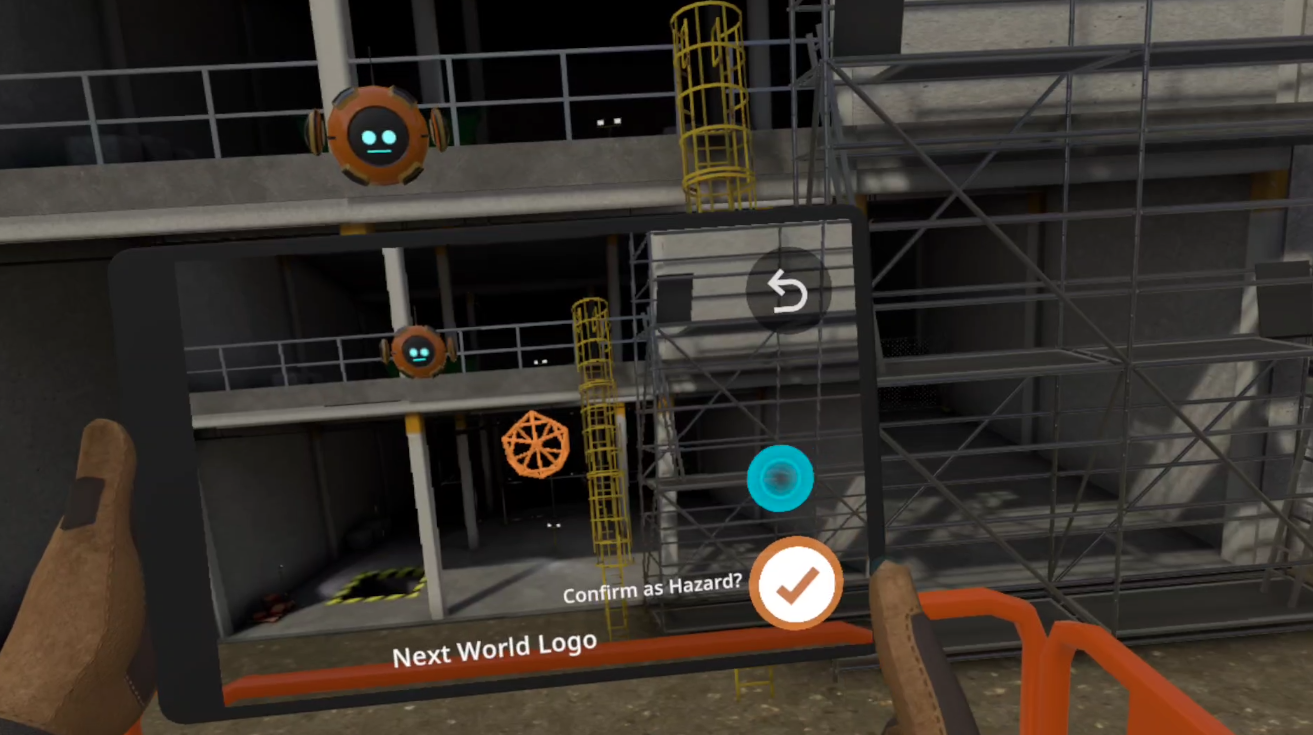


- Workers positioned near unprotected edges without harnesses or tethers.
- Open access holes lacking safety barriers or covers.
- Ladders placed close to power lines.
- Unstable equipment, such as scissor lifts on uneven or sloped surfaces.
- Unsecured tools near edges, including toolboxes left on scaffolding.
- Proper use of safety harnesses, guardrails, and fall-protection cages.
- Situations that require specific fall-arrest systems.
- Correct ladder selection and setup, including angle, length, and access points.
- Installation of safety barriers and warning signage.
- Use of tethered tools and secured equipment.
- Verification that PPE, including harnesses, tethers, and helmets, is worn and secured correctly.
- Assessment of environments as safe or hazardous.
- Identification of missing actions, controls, or equipment.
- Correction of unsafe conditions to reduce fall risk.
Train teams to think systematically, follow safe practices, and manage high-risk tasks through an immersive program centered on working at height. Participants enter a controlled virtual environment where they identify hazards, assess risk levels, and apply correct control measures without physical exposure. The experience builds essential knowledge and prepares workers for real job-site conditions.
Working at height remains a primary cause of workplace fatalities, often linked to insufficient training and limited hazard awareness.
Participants operate in a simulated high-risk environment and are required to:
- Identify fall hazards across rooftops, scaffolds, and elevated worksites.
- Perform a complete site-safety inspection under assessment conditions.
- Apply the Hierarchy of Controls to reduce risk.
- Select and use fall-protection equipment correctly and confidently.
- Respond to emerging hazards with accurate, timely decisions.
The VR format supports practical skill development, fosters confident reactions, and strengthens a proactive safety culture in elevated environments.
Features
- Student completion records
- VR training certificates
- Training results
- Behavioral metrics
- Response times
- Training groups
- Scheduling
- Set refresher training frequency
- Modelled from Unit of Competency: RIIWHS204E
English, Arabic, Bosnian, French, German, Hindi, Italian, Lao, Malayalam, Mandarin – Simplified Script, Mandarin – Traditional Script, Polish, Portuguese, Serbian, Spanish, Urdu
12 minutes run time (Including tutorial)
VR
Stand-alone
3D
Training, VR
Next World